Showing posts with label Wild Dog Safari. Show all posts

Sunday, June 6, 2010

It’s All Over Now :-(

 Our last day on the Safari was just a straight shot through travelling back to Windhoek, with a few stops for comfort and food. It was sad to say goodbye to our fellow travellers, especially Ben who had been with us the whole 2 weeks, as we dropped them off one-by-one at their various guesthouses. Last of all we said goodbye to our camp assistant Erastus and guide Elias in whose hands we had been for the whole tour.
Erastus was a hard-working young man that could not do enough for us during the trip, and kept us so well fed each day that we both think we have put on weight...! Our Guide Elias was a proud Namibian of the Damara tribe, who was not only an extremely professional and knowledgeable guide, but was also a man of profound sensitivity and understanding, and a supreme ambassador for his country. The landscape, culture and wildlife of Namibia was impressive enough, but Elias brought it to life and made us feel that we had experienced something more than just being tourists in his country.

And that brings us almost up to date. Fiona & I are now staying in a beautiful guest house called Terre Africa for the next few nights, to rest and relax before heading off to Cape Town to meet up with Yates and start the second phase of this trip. By the way, don’t worry that I am spending all my free time slaving away over a hot blog just to keep you informed, I am sitting in a veritable ‘Garden of Eden’ of water features, swimming pools, exotic plants and birdlife, connected to a free wi-fi connection. It’s a hard life but someone has to do it, as you can see from the photo below.

The Sand Dune Sea

After a bit of a luxurious lay in, the next day was effectively another travel day as we covered some ground back north along the edge of the Namib-Naukluft Desert towards our next destination, Sesriem, arriving at sunset. We set up camp and had a hearty meal, and got another early night, as tomorrow we would be up at 5:00am to head out into the desert to watch the sunrise from the top of a sand dune...!

Up and bleary eyed we set off in the dim pre-dawn light towards dune 45 in a place called Soussusvlei, (pronounced Sue-sue-fly). Dunes around here are not your common-or-garden variety you find in your usual seaside town, no, these puppies grow to between 150-350m tall, stretch for literally hundreds of kms and are comprised of a dark glowing red sand. This was another of the highlights of the tour that we had been waiting for and we were not disappointed. Arriving at Dune 45 with less than half an hour before sunrise, we were presented with a hike up the steep edge of the dune which was frankly the most energy sapping thing I have done in a long time. Fiona & I made the bold decision not to climb 150m to the top with a crowd of mainly strapping Germans or Scandinavian types, but we found our own little romantic spot about 100m up and perched there. Watching the sun rise over a sea of red dunes (while recovering from the lung-busting climb) was a real experience. The ever changing colours and contrasts, mixed with the moving shadows and shafts of light was breathtaking (or was that the climb..?). Five minutes after the sun had risen, Fiona and I were back down at the truck, tucking in to a cooked breakfast, kindly prepared by our Guides.

After breakfast (it was still only 7:45am) we set off on a 5km hike through the dunes towards the world-famous Dead Vlei, where the sand had cut off the flow of the intermittent river to a grove of Acacia trees some 500 years ago. This left the eerie sight of 50 or so dead trees in a white clay pan, surrounded by some of the biggest dunes in the whole area.

The hike was easy on the flat, and the climb up the dunes was tempered with the fun of running down the other side in an avalanche of sand. Our guide Elias was a wealth of information about everything living, dead or otherwise in this strangely isolated and beguiling place and made the time fly by. One last dune to climb and we were on the edge of the Dead Vlei, and presented a stunning vista of the stark and desolate beauty of this special place. We walked down into the vlei and stood amongst the silence of the dead trees, sweltering in the early morning sun, and looking in awe at the massive dunes surrounding us. We spent a good 45 mins there, exploring the area and taking many photo’s. For me, this was the best moment of the whole trip, standing with my arms outstretched to feel what little breeze there was, and just soaking in the atmosphere and ambience of this extreme place.

Slowly we made the gradual climb out of Dead Vlei and plodded across another stretch of parched clay and soft sand to pick up a 4x4 back to where we started our hike. Travelling back toward the campsite, now in the daylight we could see the huge, ever-moving dunes, flanking us on both sides, amazed that this formation of dunes had been around for thousands, maybe millions of years, stretched over a massive area accounting for almost 25% of the whole of Namibia. It had been a great day.

For the last night of the safari we camped at a place called ‘Agama’ in probably the best appointed campsite we had yet found, with fantastic circular facilities, a swimming pool, and bar with a sunset viewing platform built on top.... What else could a man want, and I thoroughly enjoyed sucking down a beer or two by the pool and then having another whilst watching the sun set on a fabulous day.

Saturday, June 5, 2010

Adventures in the Forbidden Zone

Next a change of direction, as we start heading west again towards the Atlantic, for a 2 night stop-over at a campsite near a remote town called Aus. Once again the scenery changes again from low scrubland to rugged tree-less desert and vast empty plains in only a few hours driving across the country. We arrive in the early afternoon, set up camp and have a couple of well deserved hours to relax & chill out before we are scheduled to take a short hike to a sunset viewing point.

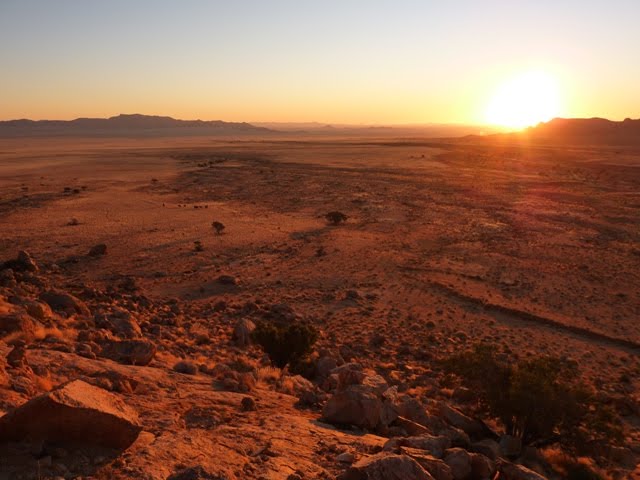
The viewing point was only about 30 mins walk away and brought us out on to an elevated position looking across the plains. As seems to be usual in Namibia, there was another awesome sunset, contrasting the red of the sun, the blue of the sky and the multi-coloured desert. We had an early night, as the next day was an early one.

Up early for a 6:40am departure, we were soon heading off across the desert heading towards Luderitz, a small historic southern port. Luderitz sits in an interesting position as one of only 2 ports in the whole of the 1500km + Namibian coastline, as it is completely surrounded by the ‘Forbidden Zone’, (or Sperrgebiet in German). Back in the late 19th Century diamonds were found in this area just lying on the surface of the desert, presumably the remains of long eroded and disappeared mountains. After the initial discovery, the German government of South West Africa of the time, slapped a ban on anyone entering the area without their permission. It is still a forbidden area requiring permits and such, as it is still mined for diamonds even now.

We passed through the Forbidden zone on our way to Luderitz, where we were scheduled on an 8:00am boat trip along the coast. The Namibian coast is well known for being foggy and misty in the mornings, as it was in Swakopmund, but today greeted us with glorious golden rays of warm sunshine, set in a crystal clear blue sky, with a gentle haze over the water and in the far away bays. The Sedina was an old wooden sailing boat that plied through the glassy sea with ease out around the headlands, and on towards Dias Point and the distant islands. The captain was a cantankerous white Namibian who’s solution to all the problems with Namibia and South Africa involved the use of firearms, (including politics, sport and conservation...!!), but he did know his sea-life, and pointed out what was on offer. Strangely we saw a gaggle of Flamingos feeding in a rock pool of the islands, many seals, dolphins and even a colony of penguins. It was a great way to start day.

Next it was back in the truck for a guided tour of the nearby ghost-town of Kolmanskop, originally built by the German settlers as a mining town to make the most of the local diamond fields. It was in use from around 1906 thru to 1943 to varying degrees, but then was abandoned to the desert. Today it stands as a reminder of a bygone era as the buildings gradually fall apart and the land is reclaimed by the ever shifting sands. The tour was great and we got to climb around the site looking at these old gothic ruins, some of which were quite surreal with half a sand dune running through the middle of them.

Back to Luderitz for lunch, and Fiona & I decided to risk-it-all and go for some local fish & chips, which were actually not half bad. Back in the truck once again and off to another headland and another cross planted by those pesky Portuguese, (they get everywhere) and then finally on to see the feral horses of Guarab and back to camp. It was a busy day and I was glad to be back in the tent for a nice lie down and 40 winks.

The Southern Swing

After a comfortable night back at the Tamboti Guesthouse, where we stayed on our first few nights in Windhoek, we were once again off on safari, this time doing a broad sweep of the south of Namibia. I was personally looking forward to this part of the trip as it was more focused on seeing the various extremes of landscape and features of Namiba than the animals and culture. The whole of this first day was spent in a tedious drive southward, but when you consider that Namibia is 4x the size of the UK, an extended period of travel was to be expected. The good news was that for this part of the safari there were only another 4 other guests accompanying us, in comparison to the 11 fellow passengers from last week, and therefore it would be a more comfortable affair. After over 6 hours of travelling we arrived at our campsite after sunset, with a bone chilling wind blowing in from the south. This was to be our coldest night under canvas.

We awoke early the next morning to a bright sunny morning that seemed no warmer than the night before, but the wind that had woken us during the night was dropping, so we hoped for a warmer day ahead. Our campsite was adjacent to the Quiver Tree Forest heritage site which we had not seen in the dark of the previous evening, but was startlingly obvious in the daylight. The Quiver Tree, so named because the local San tribesmen used the hollowed out limbs of the trees as a quiver for their arrows, is a peculiar type of Aloe that only grows in Namibia and small pockets of northern South Africa, and this site represented the highest concentration of Quiver trees in the world. They were odd looking trees in a surreal kind of way, growing out of the rocky boulders that were strewn across the landscape, casting weird shapes and shadows in the early morning light.

Next we had a wander through impressive rock formations of what was called the Giants Playground, on account of the fact that the rocks looked like they had been stacked purposely by benevolent giants. It was cold enough to make us wear hats, scarves and warm jackets and we were glad to hop on to the truck and carry on our journey south.

We were heading now towards one of what Fiona & I considered the highlights of this part of our trip, the Fish River Canyon, a massive gash in the arid Namib Desert over 100kms in length and 550m deep. This canyon was up until recently thought to be the 2nd largest in the world, after the Grand Canyon in the USA, and is still ranked 3rd after a newly discovered canyon in Ethiopia. As you approach over the barren wastes there is little warning that the canyon is there until you suddenly reach its edge, where you are confronted with a view of almost biblical proportions. It was a stunning site, and standing on its rim made you feel so small and insignificant, as if the slightest gust of wind might blow you in. We travelled along the rim for a couple of kms to another viewing point, and the scale of the place was no less impressive. It is possible to do a 5 day, 80km hike into the canyon, but that is only for the hardiest of explorers and we will save that adventure for another day... We doubled back and drove another few kms along the western part of the rim for even more spectacular views. The Fish River Canyon had lived up to its hype, and I was fully satisfied that we had witness one of the many wonders of Namibia that not too many get to see.

That night we stayed at a fantastic campsite situated just outside the canyon park, which had a myriad of old cars and tractors littering the place like works of art, and some of the best facilities we had encountered. This is a good point to mention that all of the many campsites we had stayed at were excellently appointed, with clean and well maintained facilities, and a lot better than any campsite that I have stayed at in New Zealand, USA or Europe. Considering we were travelling in one of the hottest, driest, and most arid places in the world, water was abundant, for the most part drinkable, and even the shower pressure acceptable in most places. I think the rest of the world could learn a lesson from Namibia and the infrastructure they provide for the tourist campers.

The campsite also had a main reception and lodge with one of the most interesting bars I have ever been in. Continuing the theme of old cars outside, the bar & restaurant area was a vast hanger of a building decked out with old cars, trucks, and tractors, some converted into fireplaces, some in to dining areas, and a huge collection of other Namibian transport memorabilia & signs. A big square bar sat in the middle of the room, serving some of the most expensive beer we have had on this trip, but considering that we were hundreds of miles from the nearest town, in the middle of a desert, we were not too upset. Plus we got to watch the last half of the Super 14 final there, and unexpected bonus.
The campsite was set amid some small hills with a number of walking tracks leading to the tops, so Fiona and I climb the nearest one to watch another beautiful African sunset, of which there seems to be one every night....

The Skeleton Coast and Beyond....


[NOTE] We are now back in Windhoek after the 2nd Leg of our Namibian Safari for a few days rest & relaxation before heading to Cape Town. I will now update the blog with what we have been doing since our last post.

After a day looking at various rock paintings and carvings, the following day we headed west towards the famous Skeleton Coast. As the truck made its way down the Great Escarpment towards the Atlantic, the first thing we noticed were the vast gravel plains as far as the eye could see, with an ominous fog bank in the distance. The next most obvious thing was a sudden temperature drop as we went from a hot 30 degrees on the desert plains to a chilly 15 degrees as we made our way into the coastal fog bank, and not long after we caught our first glimpse of the ocean itself.

Mile after mile of uninterrupted gravel desert coastline stretched out in all directions, featureless & lifeless except for colonies of lichen and moss, surviving on the coalescing fog. We progressed north along the coast until we reached Cape Cross, where the 15th Century explorer Diego Cao first planted a granite cross and claimed the land in the name of the Portuguese.

Very close by was the Cape Cross seal colony which you could smell and hear a long time before you could see it. I have never experienced anything like the over-powering stench of 10,000 Cape Fur Seals lazing on a vast stretch of rocky promontory, which literally made me gag. Once you got used to the small the spectacle was immense, with seals and their pups for almost as far as I could see, and I was using binoculars..! Fortunately we did not spend a tremendous amount of time there, and were soon trundling south towards tonight’s stop in Swakopmund.

Swakopmund is a large sprawling seaside town in the middle of nowhere. It was once a bustling port for the German and then South African colonists, but now is a busy town, where many of the wealthier Namibians come to escape the blistering heat of the summer. This night was to be spent in a hotel, as it is generally too cold for camping, and the first thing that Fiona and I did was head straight for the nearest laundrette, which was conveniently situated just round the corner. In a couple of hours we had a nice sweet-smelling pack of freshly laundered clothes to replace our dust encrusted and campfire smelling old ones. Such Luxury....

As this was the last night of the first week of the trip, we had a group meal at a nice pub/restaurant called the Lighthouse (recommended) where Fiona had the fish (Sole) and I reacquainted myself with the charm of eating yet another zoo animal (Oryx). A few beers, a big feed, and a soft bed were all we needed to keep us satisfied. The next day we would spend in Windhoek before heading off on the southern part of our tour of Namibia.

Friday, May 28, 2010

Rock Carvings & the White Lady

Today was going to be another long and strenuous day as we stopped heading north and finally started to head west, with plans to visit a couple of interesting rock carving sites. We drove for about 3 hours to get to Twyfelfontein, (which means ‘Doubtful Spring), to see the ‘Lion Man’ carving, created between 2-5 thousand years ago. This involved a 45 minute guided tour up and over this World Heritage site in the midday heat, (over 30 degrees), but it was worth it to see carvings of many animals, including Giraffe, Rhino, and even Seal and Penguin, even if we were over 150kms from the sea.

Next we headed to a local camping area for lunch, before another 2 hour drive to the site of the ‘White Lady’ paintings in the Brandenburg Mountains. This was an even longer hike into the rugged terrain that was going to take over 2 hours to complete, and it was still bloody hot to boot. Fortunately, as we entered the deep canyons we were soon in the shadow of the 2000m peaks around us which did help with the heat.
 
After an hour for steady climbing we reached the overhang under which the painting of the White Lady, (which is in fact actually a male shaman), could be found. It seemed a long walk for so few paintings, but they were very interesting and well worth a look.

Etosha National Park – Lions & Rhino, plus the Waterhole at night.

Day 2 in Etosha started early. The plan was to move from the Namtomi area, via the Hanali Waterhole for lunch, and arriving at the Okaukuejo camp by sunset, where they had a waterhole set up for night-viewing.

This was a long & hot day in our trusty truck, but we saw another array of animals living on the edge of the great salt pan, including Springbok, Dik-Dik, Wilderbeast, Hyenas, more Giraffes, and too many Zebra’s to count. We also managed to get a puncture just before the lunch stop and limped slowly into the Hanali rest area to repair it and have lunch.

All day long our guide Elias had said that there was a good chance of seeing Lions in Etosha, but we seemed to miss them at every turn. It was shortly before sunset when we made a last-chance dash for a distant waterhole in the hope of getting a final possibility to finally see them. We were not disappointed... As we approached we could see couple of lionesses appear on the right hand side, move slowly and languidly towards the road and on toward the waterhole. Then there was another lion, and then another, and then another, and finally in total there was a pride of 13 lions making their way across the road. It was yet another spectacular sight... But the best was yet to come...

After setting up camp and dinner, we walked through the site to the viewing area for the main waterhole. A wide swath of the area surrounding the waterhole was bathed in a soft yellow light, and standing statue still in the distance was a bull elephant. I even had to ask Fiona if it was real, it was standing so still. Then it moved a little and let out a long deep rumbling sound..., then another. Suddenly from out of the dark emerged a troop of another 10 elephants that carefully and quietly made their way down to the waterhole to drink, while the bull elephant kept a watchful eye from a distance. It was amazing, you could have heard a pin drop, there was so much drama and tension we were riveted to our seats for over an hour. More rumblings from the bull elephant, and they moved away a little, allowing time for the bull to come down to the waterhole to get his well deserved drink. Slowly they left the waterhole, only to be replaced by a few skittish Zebra and then a small family of Black Rhino. Wow, we have seen it all today, all-in-all it was one of the most awe-inspiring things I think I have ever seen.

Thursday, May 27, 2010

Etosha National Park – Giraffes, Zebra’s, Elephants, and many more....

Next day we arose very early, (before dawn), and set off towards the first of 2 days in the world renowned Etosha Game Park. We arrived in the early afternoon, set up camp, had lunch and went out for an afternoon of game viewing. At the first waterhole we saw a group of Giraffes and Zebra’s drinking, and I even spotted a tortoise...! We spent the afternoon going between waterholes where we saw a bewildering number of smaller animals, too numerous to mention...

We were hoping to see some Elephants but they were being somewhat elusive, (as elusive as a 5 tonnes, 12 foot high animal can be), but as we headed back towards our campsite near sunset, we spotted a group of 3 Elephants in the low trees alongside the road. It was a magical moment to see these magnificent beasts up close, literally within feet of us, as they moved through the bushed and out across the road behind us.

Back to camp for another fine feast prepared by our guides and an early night was in order after a busy day.

The Namibian Safari – Heading North

The next day we packed all our stuff up early, and waited to be picked up for the first part of our 14 day Namibian Safari. At this point we were not sure whether we would be heading North or South first, but we soon found that we would be going north with 11 fellow travellers.

At first the Safari truck that would be our mobile home for the next week seemed cramped and uncomfortable, but our excitement helped us forget these things while we got to know our fellow travellers. The composition of our group was 2 French, 2 Aussies, 2 Americans, 2 Germans, a Swiss, a Brit and a Scotsman. Overall they are a good bunch of people, you know there will always be someone that is not quite in synch with everyone else, (*cough* The French).

Fiona had booked the Namibian portion of our travels and I had deliberately not looked at the itinerary, therefore everything that was coming up was a complete surprise, especially as I had absolutely no idea what to expect. We headed north out of Windhoek, past a few towns with names that were frankly unpronounceable, (eg. Okahandja), on the way to the first campsite of the journey at a place called Obokojima. The setting was spectacular, high on a ridge with views over a vast area of semi arid valley, covered in low bush with patches of the deep red African soil showing through. The toilet and showers at this site were open-sided which gave you an awesome uninterrupted view out across the valley when you used them. This would be even more fun when using the facilities after dark, but luckily there was going to be a quarter moon, which was plenty bright enough to see by. Our guides (Elias & Erastus) showed us how to erect the tents, made us lunch, and prepared us for our first game drive.

The campsite is on a piece of land that also houses an organisation called ‘AfriCat’, and we were going off to some of their saved animals. Firstly we had a very up close and personal meeting with Leopard called Wally as he was fed large pieces of Donkey meat, (apparently the cheapest meat in Namibia..!). It was stunning to be sitting no more than 10 feet from this amazing creature, while it prowled around the feeding enclosure and devoured it’s food. I have never been much into wildlife viewing, but this was something else. After 20 minutes with ‘Wally’ we then drove over to another enclosure to see 3 Cheetahs basking in the late afternoon sun. We were literally parked a couple of feet away from them as they lay in the grass, and even then they were difficult to see.

We got back to camp at sunset and sat and drank a few beers while the guide made our dinner, which was very tasty and plentiful. If today was a taste of what was to come then we in for a great trip.